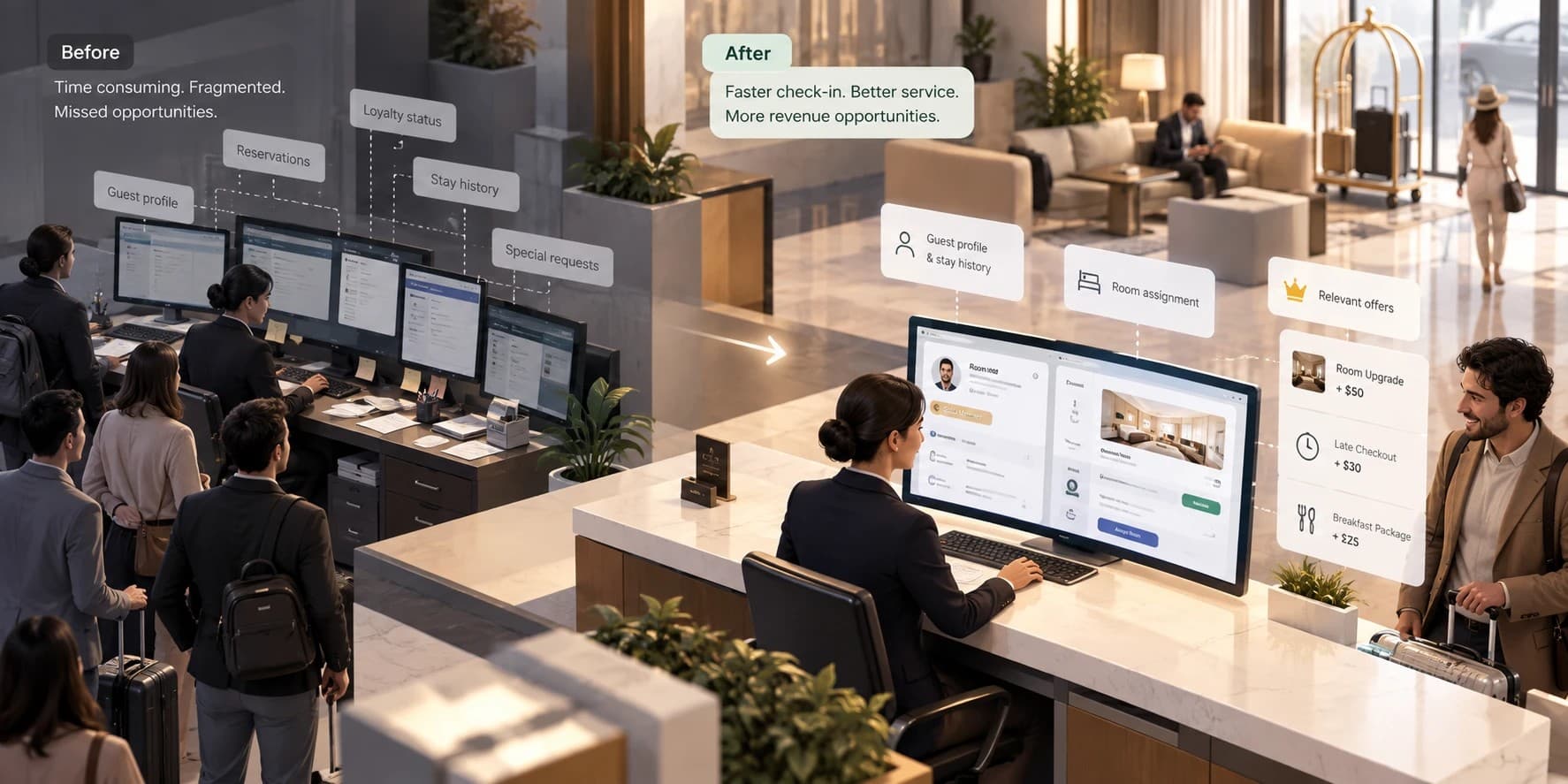
Reduced Check-in Time Toward a 2-Minute Target & Increased Upsell Revenue
Agilysys PMS · Design Manager · 4 months
The Story
Peak season. Full lobby. Staff under pressure.
It was peak season. Guests who had just arrived after long journeys were standing in line, tired and impatient. Behind the front desk, staff were moving as fast as they could — but the system was working against them.
Every check-in took 4 to 5 minutes. Staff had to dig through dense screens, search for information, switch between views, and manually handle different guest requirements.
While they were buried in the interface, opportunities to offer a room upgrade, late checkout, or breakfast package quietly slipped away.
Guests waited longer. Staff felt pressure. And the hotel lost opportunities that could have been earned during those critical first minutes of the stay.
The opportunity
Make the process:
- Fast enough to respect the guest's time
- Clear enough to reduce staff stress
- Smart enough to surface revenue opportunities at the right moment
Context & Challenge
The existing experience created three connected problems
4–5 minute check-in
Long processing time created queues during peak periods.
High cognitive load
Staff navigated dense screens, searched for information and switched between views.
Missed revenue opportunities
Staff had limited time and mental bandwidth to offer upgrades, late checkout or breakfast packages.
Core problems
- High time cost of check-in limited revenue opportunities
- Information was hard to find and poorly prioritized
- Existing interface created high cognitive load
- Architecture and legacy constraints limited radical changes
- Staff would need to learn a new interaction model
Success metric
Enable staff to complete guest check-in within 2 minutes.
My Role & Team
Design ManagerI owned
- Direct engagement with onsite Product Owners
- Understanding current interface pain points and operational realities
- Problem framing
- Re-imagining the solution under real constraints
- Overall design direction
- Prioritization
- Design quality
- Stakeholder alignment
- Mentorship
Team owned
- Day-to-day design exploration
- Wireframes
- Prototypes
- Collaboration with Business Analysts
Team: 1 Senior Designer + 2 Designers
My leadership focus
I coached the designers on how to approach large, ambiguous requirements — breaking them into smaller chunks and validating assumptions early through POCs.
How I Led
Discovery & Alignment
I conducted multiple workshops with stakeholders and directed the team to research competitive hotel check-in experiences, industry best practices, and how guests and staff interact during arrival.
Problem Structuring & Mentorship
I guided the team to break the large requirement into manageable pieces and treat early explorations as POCs. This helped validate assumptions quickly, reduce risk and build team confidence.
Validation
We tested multiple concepts with existing customers, gathered feedback and iterated before finalizing the direction.
Constraints & Trade-offs
Desktop-first was a deliberate trade-off
The two-panel layout is not ideal for mobile screens.
However, staff check-in is performed almost exclusively on desktop.
We therefore accepted the mobile limitation in favor of:
Existing architecture
Limited how radically the experience could change.
Critical information above the fold
The design had to maintain access to important data without unnecessary scrolling.
4-month timeline
Required focused prioritization and early validation.
New interaction model
Staff would need to learn a different way of working.
Outcomes & Impact
Leadership Reflection
Lead the outcome, not the interface
The goal wasn't simply to make check-in faster. We had to improve operational efficiency while protecting the guest experience and creating room for business opportunities.
Design is about navigating trade-offs
Enterprise products rarely offer a clean slate. The team had to balance user needs, business priorities and existing product constraints to arrive at a practical solution.
Give direction, then create space
My role was to establish the problem, target and design direction while giving the team ownership of exploration and execution. This helped the team make stronger decisions without relying on me for every answer.